Ati-atihan de Boracay
Jan 16 2008 Wed
2:15 am PHT
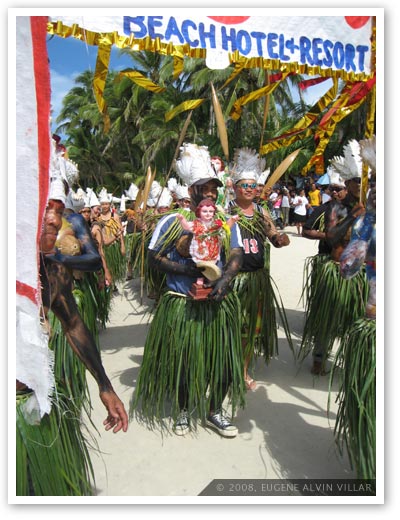
Last weekend I was in Boracay together with several travel and photo bloggers and some of us (at least those who woke up early on a Sunday morning) had the lucky chance to witness the island’s version of the Ati-atihan Festival which apparently is celebrated one week earlier than the mother festival in Kalibo, Aklan. This year, the celebration was on January 13 and the parade started at the Balabag Plaza after the Holy Mass and wound its way along the stretch of Boracay’s White Beach before going back to the Plaza via the internal roads.
This is the first time I’ve been to Boracay and it’s also the first time that I got to see a major Philippine festival, albeit a less ostentatious version. I’ve been told that the Kalibo festival is a much more grander and fantastic event—the Ati-atihan has been called the Mother of all Filipino Festivals and also the Mardi Gras of the Philippines.


L-R, T-B: 1. Soot-covered revelers in the traditional Ati-atihan style of costumes. 2. A typical drum-and-bell-lyre band that accompanies the parade. 3. A Sto. Niño devotee carrying an image of the Child Jesus. 4. Plaque marking Balabag Plaza where the parade started. 5. Aklanons covering their bodies with soot. 6. A view of the Mass before the parade; the Mass was celebrated at the Balabag Plaza outside the church. 7. A MassKara Festival mask?! I’m sure I was in Boracay, not Bacolod 
The Ati-atihan Festival is a Catholic fiesta native to Aklan that celebrates the feast of the Sto. Niño or the Child Jesus. And like many other Catholic fiestas, this one traces its roots to a pagan festival, one that commemorated the arrival of the ten Malay datus (chieftains) from Borneo to Panay Island. These datus bought the lowlands from the native Ati tribes and this event is immortalized in the Ati-atihan where celebrants paint their bodies with soot to mimic the Ati tribe—thus “ati-atihan.”
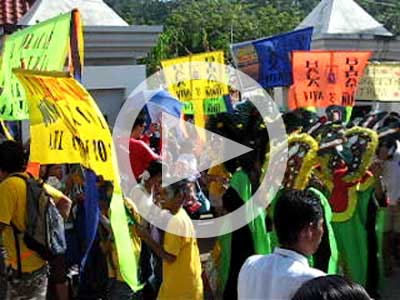
Aside from the pictures above of which there are more in Flickr, I also managed to capture a video, which I uploaded to YouTube. Sorry for the crappy quality of the video; I’ve had trouble uploading so I opted for a smaller video size. (Another blogger, Noemi Dado, has also uploaded a video.)


Comments
[an error occurred while processing this directive]